
Gas vs Hybrid Cars: What’s the Real Difference?
Gas vs hybrid cars differ in one fundamental way: a hybrid uses both a gasoline engine and an electric motor, while a traditional gas car relies on its combustion engine alone.
Here’s a quick side-by-side to help you decide at a glance:
| Feature | Gas Car | Hybrid Car |
|---|---|---|
| Power source | Gasoline only | Gas engine + electric motor |
| Typical MPG | 25-30 mpg | 40-60 mpg |
| Average upfront cost | Lower | ~$1,300-$3,000 more |
| Maintenance complexity | Simpler | Slightly more complex |
| Emissions | Higher | Lower |
| Best for | Highway, rural, budget buyers | City driving, high-mileage commuters |
| Refueling | Gas station only | Gas station (PHEVs can also plug in) |
The gap between these two options has narrowed a lot in recent years — in price, performance, and everyday usability. Some popular models like the Toyota Camry and RAV4 have even gone hybrid-only.
For budget-conscious drivers watching every dollar at the pump, the choice between gas and hybrid isn’t just about technology. It’s about how you drive, how far you drive, and what you can afford upfront.
This guide breaks it all down in plain language — no engineering degree required.

How Gas vs Hybrid Cars Actually Work
At Zonatech4, we believe that understanding your vehicle is the first step toward sustainable travel. When we look at the mechanics of gas vs hybrid cars, we aren’t just looking at metal and wires; we’re looking at how energy is managed.
The Traditional Gasoline Engine
Think of a traditional gas car as a one-man show. It relies entirely on an internal combustion engine (ICE). You fill up a fuel tank, and that gasoline is pumped into the engine. Inside, spark plugs create tiny controlled explosions that push pistons up and down. This movement creates mechanical power, which the transmission sends to your wheels.
It’s a system that has worked for over 100 years, but it’s inherently “leaky” when it comes to energy. Every time you hit the brakes in a gas car, the energy used to move the car is turned into heat and simply disappears into the air.
Three Types of Hybrid Systems
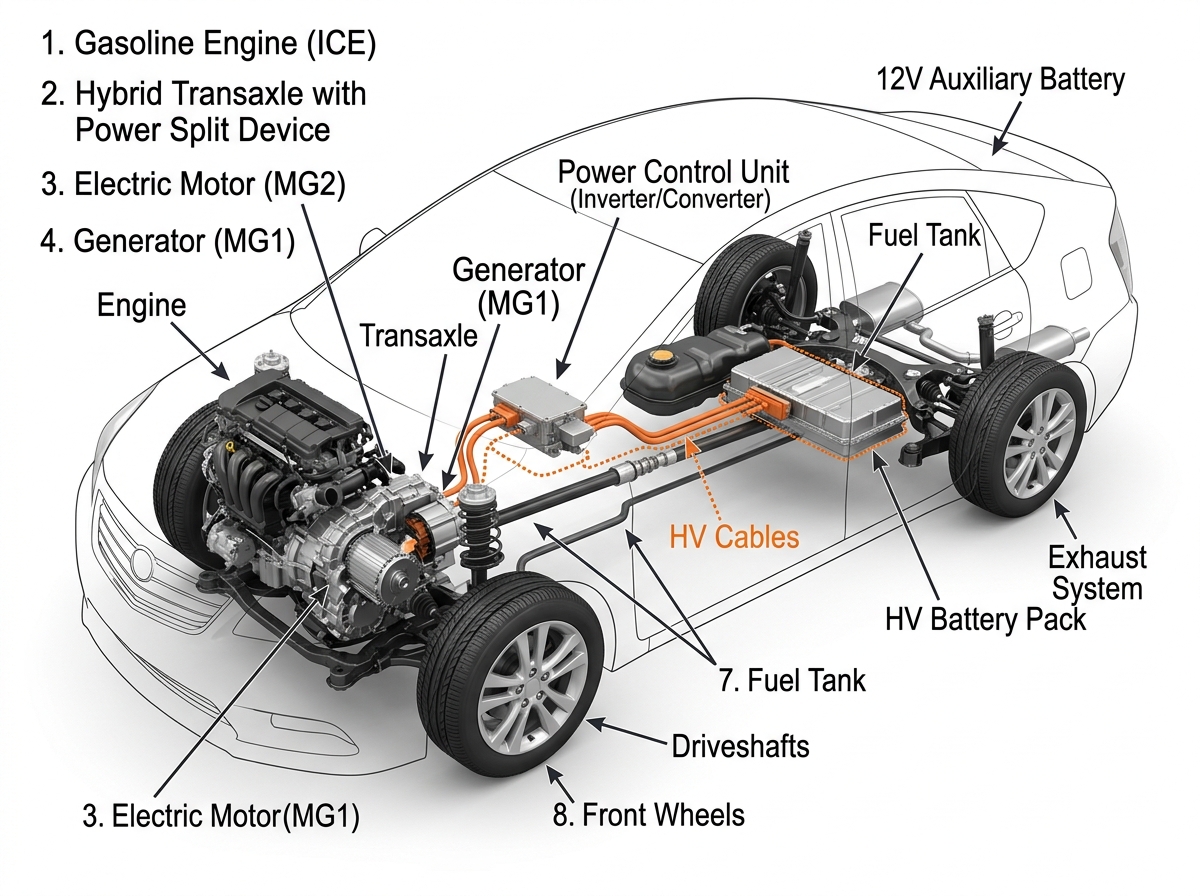
Hybrids are like a team. They still have that gas engine, but they bring in an electric motor and a traction battery to help out. The magic word here is regenerative braking. Instead of wasting energy when you slow down, the electric motor acts like a generator, capturing that kinetic energy and storing it in the battery for later use.
There are three main ways this team works together:
- Mild Hybrids: These use a small motor-generator instead of a traditional alternator. They can’t drive on electricity alone, but they help the engine run accessories and give it a tiny boost during acceleration.
- Full Hybrids (HEVs): These are the most common (like the famous Toyota Prius). They can drive on pure electricity at low speeds (usually under 25 mph) and switch to the gas engine when you need more power. You never plug these in; they charge themselves while you drive.
- Plug-in Hybrids (PHEVs): These have much larger batteries and an electric-only range of 25 to 50 miles. You can plug them into an external outlet to “fill up” on electricity. Once the battery runs low, they turn back into a regular full hybrid.
Comparing Performance and Driving Experience
One of the biggest myths we hear is that hybrids are “slow” or “boring.” While that might have been true twenty years ago, modern technology has flipped the script.
Power and Smoothness in Gas vs Hybrid Cars
When comparing the driving feel of gas vs hybrid cars, the first thing you’ll notice is the silence. In a hybrid, starting the car and pulling out of your driveway is often completely silent because the electric motor is doing the work.
Hybrids also offer instant torque. While a gas engine has to “rev up” to reach its peak power, an electric motor delivers its full strength the moment you touch the pedal. This makes hybrids feel very peppy in stop-and-go city traffic.
However, on the highway, gas cars often feel more “traditional.” Some drivers prefer the predictable shifting of a standard transmission over the Continuously Variable Transmission (CVT) found in many hybrids, which can sometimes produce a “droning” sound during hard acceleration.
Real-World MPG: Toyota Corolla and Honda CR-V Examples
The numbers don’t lie. When we look at the 2026 model year, the fuel efficiency gap is staggering, especially in city driving where hybrids shine.
| Model | Gas Version (City/Hwy) | Hybrid Version (City/Hwy) |
|---|---|---|
| 2026 Toyota Corolla | 32 / 42 MPG | 53 / 46 MPG |
| 2026 Honda CR-V | 28 / 33 MPG | 43 / 36 MPG |
| 2025 Ford Maverick (AWD) | 22 / 30 MPG | 40 / 34 MPG |
Notice how the hybrid’s city mileage is often higher than its highway mileage? That’s because the electric motor does the heavy lifting in traffic, whereas the gas engine takes over more on the highway.
The Financial Breakdown: Upfront Cost vs. Long-Term Savings
Let’s talk about the elephant in the room: the sticker price. On average, you can expect to pay about $1,300 more for a hybrid car or up to $3,000 more for a hybrid SUV compared to their gas-only counterparts.
For example, the 2026 Honda CR-V LX (gas) starts at $32,370, while the Sport Hybrid starts at $37,080. However, for smaller cars, the gap is closing. The 2026 Toyota Corolla LE (gas) starts at $24,120, while the Hybrid version is only $25,970—a difference of less than $2,000.
Maintenance, Insurance, and Resale Value
A common concern is that hybrids are more expensive to fix. In reality, it’s a wash.
- Brakes: Hybrid brake pads often last much longer because regenerative braking does most of the work slowing the car down.
- Oil Changes: You still need them! Even though the gas engine runs less, it still requires lubrication and cooling.
- Batteries: This is the big one. Hybrid batteries are designed to last the life of the car, but if they do fail out of warranty, replacement costs range from $1,000 to $3,000.
- Resale Value: Hybrids are currently in high demand. They tend to retain 50-60% of their value after five years, whereas gas cars often sit between 40-50%.
Calculating the Payback Period for Gas vs Hybrid Cars
How long does it take for those gas savings to pay back the higher purchase price? Let’s use the Toyota Corolla as an example.
- Gas Corolla fuel cost: ~$1,434 per year (at 15,000 miles).
- Hybrid Corolla fuel cost: ~$975 per year.
- Annual Savings: $459.
With a price premium of roughly $1,375, it would take about three years to break even. After that, the hybrid is putting money back in your pocket every month. If gas prices spike to $5.00 a gallon, that payback period happens even faster! Plus, some PHEVs are still eligible for federal tax credits of up to $7,500, which can wipe out the price gap instantly.
Environmental Impact and Sustainability
At Zonatech4, we’re passionate about reducing our collective carbon footprint. While neither car is “zero emission” like a full EV, hybrids are a massive step up from traditional gas vehicles.
By burning less fuel, hybrids release significantly fewer tailpipe pollutants and CO2 emissions. This is especially important for urban air quality. When a hybrid sits in a drive-thru or at a red light, the engine usually shuts off entirely, meaning zero emissions while idling.
While the production of lithium-ion or nickel-metal hydride batteries has an environmental cost, most lifecycle analyses show that the fuel saved over the life of the vehicle far outweighs the “carbon debt” of making the battery.
Which One Should You Buy?
There is no “perfect” car, only the car that is perfect for your lifestyle.
When a Hybrid Makes More Sense
We recommend a hybrid if:
- You live in a city: Stop-and-go traffic is where hybrids dominate.
- You have a long commute: If you’re driving 15,000+ miles a year, the fuel savings will be massive.
- You want a “forever” car: With high resale value and proven reliability, hybrids are excellent long-term investments.
- You don’t have a home charger: If you want the efficiency of an EV but live in an apartment without a plug, a full hybrid is the smartest move.
When a Gas Car is the Better Choice
A traditional gas car might still be the winner if:
- You mostly drive highways: At steady speeds of 70 mph, the hybrid system has fewer chances to “regenerate” energy, and the MPG gap narrows.
- You’re on a strict budget: If you need the lowest possible monthly payment right now, the lower MSRP of a gas car is hard to beat.
- You live in a very rural area: If the nearest specialized mechanic is three hours away, the simplicity of a standard gas engine can offer peace of mind.
- You need heavy towing: Most compact hybrids aren’t rated for heavy trailers; a dedicated gas or diesel truck is still the king of the ranch.
Frequently Asked Questions about Gas vs Hybrid Cars
Do hybrid cars still need oil changes?
Yes! Because a hybrid still uses an internal combustion engine, it requires regular oil changes to keep the parts lubricated and cool. Most manufacturers recommend synthetic oil every 7,500 to 10,000 miles, similar to modern gas cars.
How long do hybrid batteries last?
Most manufacturers provide a warranty for 8 to 10 years or 100,000 to 150,000 miles. In the real world, many hybrid batteries last well beyond 200,000 miles before they show significant degradation.
Can a hybrid car run if the battery dies?
It depends on the “health” of the battery. If the big traction battery completely fails, most hybrids will enter a “limp mode” or refuse to start because the battery is responsible for starting the engine. However, if the small 12-volt battery (the one that runs the lights) dies, you can jump-start it just like a regular gas car.
Conclusion
Choosing between gas vs hybrid cars doesn’t have to be a headache. If you value efficiency, quietness, and long-term savings—and your budget allows for a slightly higher upfront cost—the hybrid is a fantastic choice for the modern traveler. If you prefer simplicity and the lowest possible entry price, the traditional gas engine still has plenty of life left in it.
At Zonatech4, our mission is to help you navigate these choices with ease. By adopting fuel-efficient driving habits and choosing the right vehicle for your needs, you’re not just saving money—you’re contributing to a more sustainable future for everyone.
