
The Best Fuel Efficient Hybrid Cars for 2026 (Ranked by MPG)
Fuel efficient hybrid cars are the smartest way to cut fuel costs without giving up range or comfort on long drives. Here’s a quick look at the top options for 2026, ranked by EPA combined MPG:
| Rank | Model | EPA Combined MPG | Starting Price |
|---|---|---|---|
| 1 | 2026 Toyota Prius | 57 MPG | $29,745 |
| 2 | 2026 Hyundai Elantra Hybrid | 54 MPG | $26,695 |
| 3 | 2026 Kia Niro Hybrid | 53 MPG | $28,885 |
| 4 | 2026 Toyota Camry Hybrid | 51 MPG | $30,495 |
| 5 | 2026 Toyota Corolla Hybrid | 50 MPG | $25,970 |
Gas prices aren’t getting cheaper. And if you spend any time on the road — whether commuting or heading out on a weekend adventure — the vehicle you drive makes a real difference to your wallet and your carbon footprint.
Hybrid vehicles blend a gasoline engine with one or more electric motors. The result is dramatically better fuel economy than a traditional gas-only car, often without any need to plug in. You get the range and convenience of gas with a big boost in efficiency.
The 2026 model year is one of the strongest ever for hybrid options. You can now choose from efficient sedans, practical SUVs, capable trucks, and even sporty crossovers — many starting well under $35,000.
This guide compares the top fuel efficient hybrid cars across categories, so you can find the right fit for your needs and budget.
Top 5 Most Fuel-Efficient Hybrid Cars for 2026
When we look at the landscape for 2026, the competition for the title of “efficiency king” is fiercer than ever. Manufacturers are no longer just trying to hit 40 MPG; they are pushing deep into the 50s. Based on the latest data, here are the top performers that will keep you away from the pump for longer.
1. Toyota Prius
The Toyota Prius remains the undisputed champion of efficiency. For 2026, the base LE Front-Wheel Drive (FWD) model achieves a staggering 57 MPG combined. Beyond the numbers, the Prius has undergone a total style transformation. It no longer looks like a “science project”; it features an athletic silhouette and modern Japanese design. With a starting MSRP of approximately $29,745, it offers a 2.0L 4-cylinder hybrid engine producing 194 horsepower. For those of us living in areas with unpredictable weather, the AWD variant is a great choice, still delivering a highly impressive 54 MPG. You can find more details on the 2026 Toyota Prius | Toyota.com.
2. Hyundai Elantra Hybrid
Coming in a close second is the Hyundai Elantra Hybrid. The “Blue” trim is the star here, netting an EPA-estimated 54 MPG combined. It is one of the most affordable ways to get into a high-efficiency vehicle, with a starting price of around $26,695. We love the Elantra for its spacious interior and the fact that it can travel over 600 miles on a single tank of gas. It’s a perfect companion for those long-distance eco-adventures we advocate for here at Zonatech4.
3. Kia Niro Hybrid
The Kia Niro proves that you don’t need a low-slung sedan to get elite fuel economy. This subcompact crossover offers 53 MPG combined in its FE trim. Starting at $28,885, the Niro provides a higher seating position and more versatile cargo space than its sedan competitors. It uses a 1.6L hybrid engine that balances 195 lb-ft of torque with incredible sipping habits.
4. Toyota Camry Hybrid
The Toyota Camry has made a bold move for the new generation: it is now exclusively a hybrid. The base LE trim earns 51 MPG combined, a remarkable feat for a mid-size sedan. Starting at $30,495, the Camry offers a more refined, comfortable ride for families or business travelers who want to maintain a professional look while prioritizing sustainability.
5. Toyota Corolla Hybrid
Rounding out our top five is the Toyota Corolla Hybrid. With a starting price of $25,970, it is often the most budget-friendly entry on the list. It achieves a solid 50 MPG combined. It’s a “no-nonsense” vehicle known for extreme reliability and straightforward tech. You can check out the full specs at 2026 Toyota Corolla | Toyota.com.
For a deeper dive into how these models stack up in professional testing, check out the Best Hybrid Cars for 2026, Tested – Car and Driver.
Understanding Hybrid Technology: HEV vs. PHEV vs. Mild Hybrids
Before we head out on our next big adventure, it’s important to understand the “flavor” of hybrid we’re driving. Not all fuel efficient hybrid cars work the same way.
Standard Hybrids (HEVs)
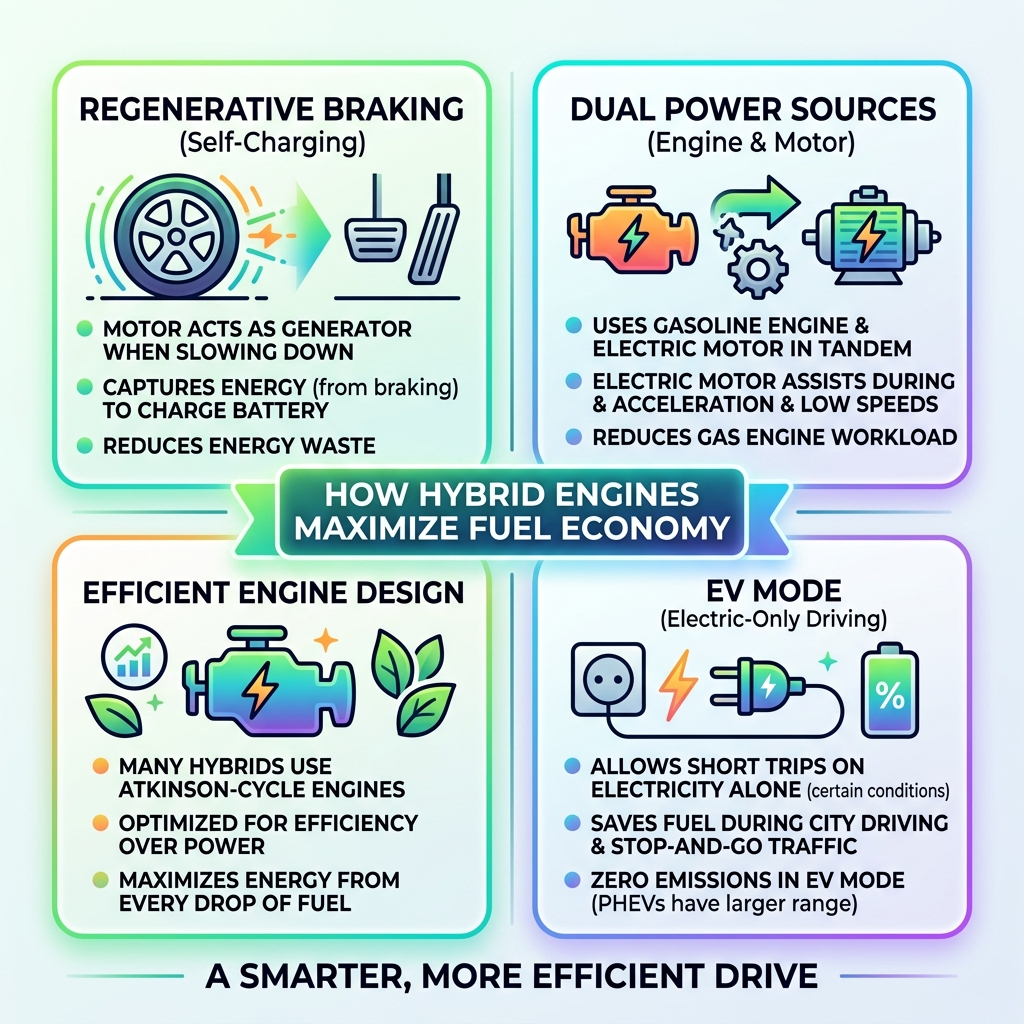
These are “self-charging” hybrids. You never plug them in. They use a gasoline engine and electric motors in tandem. The battery is charged through regenerative braking—a process where the electric motor acts as a generator when you slow down, capturing energy that would otherwise be lost as heat. Most of the top 5 models listed above are HEVs. They often use an Atkinson-cycle engine, which is designed specifically for high efficiency rather than raw power.
Plug-in Hybrids (PHEVs)
PHEVs, like the 2026 Toyota Prius Plug-In Hybrid, have much larger batteries. You can plug them into an outlet to get a significant all-electric range. For example, the 2026 Prius Prime offers up to 44 miles of electric-only driving. This means if your commute is short, you might not use a drop of gas for weeks. Once the battery runs low, it switches to a standard hybrid mode.
Mild Hybrids
Mild hybrids are the most subtle. They have a small electric motor that assists the engine during acceleration and helps power electrical systems, but they cannot drive on electricity alone. While they improve fuel economy slightly, they don’t reach the 50+ MPG heights of full hybrids. An example is the Audi A3, which offers a premium feel but typically stays in the low 30 MPG range.
Sedans vs. SUVs: Choosing fuel efficient hybrid cars for Your Needs
We often get asked: “Can I still get great gas mileage if I need an SUV for my gear?” The answer is yes, but there are trade-offs.
The Aerodynamic Advantage of Sedans
Sedans like the Prius and Camry are sleeker and lower to the ground. This better aerodynamics allows them to slice through the air with less resistance, which is why they dominate the 50+ MPG rankings. If your adventure involves mostly highway miles and you don’t need to haul bulky equipment, a sedan is your best bet for maximum savings.
The Versatility of Hybrid SUVs
If your “Big Adventure” involves camping gear, dogs, or light off-roading, an SUV is likely necessary. While they don’t hit 57 MPG, models like the 2026 Honda CR-V Hybrid (40 MPG combined) and the Toyota RAV4 Hybrid (41-43 MPG combined) are incredibly efficient for their size.
Many modern hybrid SUVs now feature Electronic On-Demand AWD. Instead of a heavy mechanical driveshaft running to the back wheels, these vehicles use a dedicated electric motor on the rear axle. This provides traction when you need it—like on a rainy trail—without the constant fuel penalty of traditional 4WD systems. You can learn more about these versatile options at 2026 Toyota RAV4 Plug-in Hybrid | Toyota.com.
Key Considerations for Your Hybrid Purchase
Choosing from the many fuel efficient hybrid cars available requires looking beyond just the MPG. Here is what we recommend keeping in mind:
- Starting MSRP vs. Long-Term Savings: Hybrids often cost $2,000 to $5,000 more than their gas-only counterparts. We suggest calculating your annual mileage to see how quickly the fuel savings will “pay back” that initial investment.
- Safety Technology: Most 2026 models, especially from Toyota and Honda, come standard with advanced safety suites. Look for features like Safety Sense 3.0, which includes pre-collision systems and lane-keeping assist.
- Cargo Capacity: If you’re a traveler, check the cubic feet. A Prius offers about 23.8 cu. ft. of space, which is great for a hatchback, but a CR-V Hybrid will offer significantly more for families.
- Towing Capacity: Most hybrid sedans aren’t rated for towing. If you have a small trailer, look toward the RAV4 Plug-in Hybrid, which can tow up to 3,500 lbs.
- Infotainment: Ensure the car supports Wireless Apple CarPlay or Android Auto. There’s nothing worse than getting lost on an eco-road trip because your maps won’t sync!
Frequently Asked Questions about Hybrid Efficiency
Which hybrid car achieves the highest MPG?
The 2026 Toyota Prius achieves the highest MPG for a standard hybrid, reaching up to 57 MPG combined. It starts at $29,745 and features a 2.0L engine paired with a powerful electric motor. If you look at Plug-in Hybrids, the Prius Prime can reach over 120 MPGe when accounting for electric driving.
Are there affordable fuel efficient hybrid cars under $30,000?
Absolutely! The 2026 market has several excellent options for budget-conscious travelers:
- Toyota Corolla Hybrid: Starts around $25,970 (50 MPG).
- Hyundai Elantra Hybrid: Starts around $26,695 (54 MPG).
- Kia Niro Hybrid: Starts around $28,885 (53 MPG).
- Honda Civic Hybrid: Starts around $30,590 (49 MPG).
How do real-world MPG figures compare to EPA estimates for fuel efficient hybrid cars?
EPA estimates are a great baseline, but real-world results vary. In our experience and based on independent testing, hybrids often perform better than their EPA ratings in stop-and-go city traffic because the electric motor does most of the work. However, on very high-speed highway trips (75+ MPH), you might see numbers slightly lower than the estimate because the gasoline engine is working harder against wind resistance. Cold weather can also temporarily reduce battery efficiency.
Conclusion
At Zonatech4, we believe that traveling the world shouldn’t mean costing the earth. Choosing one of the many fuel efficient hybrid cars available today is one of the most impactful steps you can take toward a more sustainable lifestyle. Whether you opt for the record-breaking efficiency of the Toyota Prius or the rugged versatility of a Kia Niro, you’re choosing a vehicle that aligns with a greener future.
By combining these high-tech machines with smart driving habits—like smooth acceleration and utilizing regenerative braking—you can extend your range and minimize your footprint. Ready to plan your next eco-friendly road trip? Check out our More info about eco-travel services for more tips on sustainable travel and fuel-efficient practices. Safe travels!
