
Why Sustainable Driving Habits Save You Money and the Planet
Sustainable driving habits are simple changes to how you drive, maintain your vehicle, and plan your trips — and they can cut your fuel costs and carbon emissions significantly.
Here’s a quick overview of the most impactful habits:
| Habit | Benefit |
|---|---|
| Smooth acceleration and braking | Up to 40% better fuel economy in traffic |
| Keeping tires properly inflated | Up to 3% fuel efficiency boost |
| Staying at or below 50 mph | Avoid paying $0.18+ extra per gallon |
| Avoiding idling over 30 seconds | Save ¼ to ½ gallon of fuel per hour |
| Using recommended motor oil | 1%–2% fuel economy improvement |
| Removing roof cargo when not needed | Up to 25% better highway fuel economy |
| Using in-car feedback systems | Average 6.6% fuel economy improvement |
The average driver can improve fuel economy by roughly 10% just by driving more smoothly and keeping up with basic maintenance. That adds up to real money — and a measurably smaller carbon footprint.
Here’s the thing most people miss: it’s not just about driving less. It’s about driving smarter.
Every trip is an opportunity to waste fuel — or to save it. Aggressive acceleration, unnecessary idling, underinflated tires, and speeding all quietly drain your wallet and push more greenhouse gases into the atmosphere. In 2023, new vehicle CO₂ emissions hit a record low of 319 grams per mile — but how you drive any vehicle matters just as much as which vehicle you choose.
This guide covers everything: driving technique, vehicle maintenance, smart trip planning, technology tools, and when it makes sense to skip the car entirely.
Core Sustainable Driving Habits for Every Journey
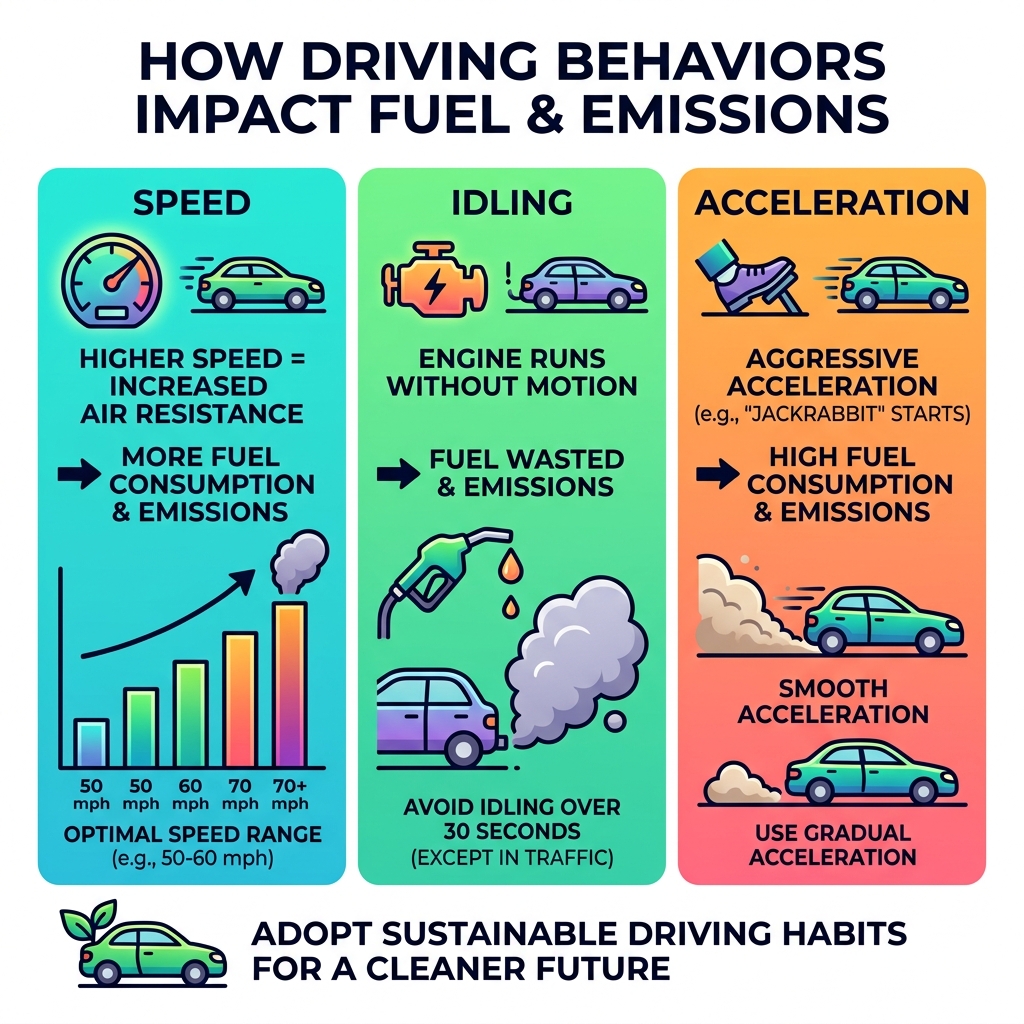
When we talk about “ecodriving,” we aren’t just talking about buying a fancy new car. We are talking about the person behind the wheel. Your behavior is the single biggest variable in your car’s efficiency. Research shows that aggressive driving—think “jackrabbit” starts and slamming on the brakes—can lower your gas mileage by a staggering 40% in stop-and-go traffic. Experts at Natural Resources Canada emphasize that smooth driving is key to efficiency.

To truly master sustainable driving habits, we need to rethink how we interact with the pedals. Instead of reacting to the car directly in front of us, we should be looking 12 to 15 seconds ahead. This “anticipatory driving” allows us to see a red light or a traffic jam from a distance.
Instead of staying on the gas until the last second, we can practice coasting to decelerate. By taking your foot off the accelerator early, most modern fuel-injected engines actually shut off the fuel flow to the injectors entirely while the car is still in gear. This is a “free” way to travel. If you’re interested in more ways to stay green while on the move, check out our guide on how to reduce-carbon-footprint-while-traveling.
Mastering Smooth Acceleration and Braking
We like to use the “cup of coffee” rule: imagine there is an open cup of coffee sitting on your dashboard. Your goal is to drive without spilling a single drop.
For gentle starts, a good rule of thumb is to take about 5 seconds to accelerate your vehicle up to 20 kilometers per hour (about 12 mph) from a total stop. This gradual increase in speed preserves kinetic energy and prevents the engine from working harder than it needs to.
Not only does this save fuel, but it also significantly reduces brake wear. Every time you slam on the brakes, you are essentially turning the fuel you just burned into heat and brake dust. By braking softly and early, you keep your money in your pocket and keep particulates out of the air.
Optimizing Speed for Sustainable Driving Habits
There is a “sweet spot” for fuel economy, and for most vehicles, it sits between 50 and 80 km/h (roughly 30 to 50 mph). Once you cross the 50 mph threshold, your fuel economy begins to drop off rapidly.
Why? Aerodynamic drag. As you go faster, the air resistance against your car increases exponentially. In fact, for every 5 mph you drive over 50 mph, you are essentially paying an additional $0.18 per gallon of gas. Driving at 75 mph instead of 60 mph uses about 18% more fuel, yet on a short trip, it might only save you two minutes.
On the highway, we highly recommend using cruise control. It helps maintain a steady pace, which prevents the tiny, fuel-wasting speed fluctuations that happen when we drive manually. For more inspiration on efficient travel, see our low-carbon-travel-ideas.
Vehicle Maintenance: The Foundation of Eco-Efficiency
You wouldn’t try to run a marathon while wearing a weighted vest and breathing through a straw, right? Driving a poorly maintained car is essentially the same thing.
The most important (and easiest) maintenance task is checking your tire inflation. Underinflated tires have higher rolling resistance, meaning the engine has to work harder just to move the car forward. Keeping your tires at the correct PSI can boost fuel efficiency by up to 3%. On the flip side, for every 1 psi drop in pressure, your gas mileage drops by 0.2%. As noted in the Consumer Guide to Fuel Economy, proper maintenance is the foundation of eco-efficiency. You can find more travel-tips-for-reducing-environmental-impact-2 on our site to keep your vehicle in top shape.
Here are a few other maintenance “must-dos”:
- Use Recommended Motor Oil: Using the manufacturer’s suggested grade can improve fuel economy by 1%–2%. Look for “Energy Conserving” on the API performance symbol.
- Engine Tuning: Fixing a car that is noticeably out of tune or has failed an emissions test can improve its gas mileage by an average of 4%.
- Reduce Aerodynamic Drag: This is a big one. A large, blunt roof-top cargo box can reduce fuel economy by 6%–25% on the highway. If you aren’t using your roof rack or bike rack, take it off! Even empty roof bars can add 7% to your fuel consumption at motorway speeds.
Choosing the Right Vehicle and Technology
While sustainable driving habits make a huge difference, the machine you drive matters too. If you are in the market for a new ride, we suggest consulting the EPA Green Vehicle Guide.
Hybrid vehicles and Electric Vehicles (EVs) are the gold standard for sustainability. EVs produce zero tailpipe emissions and are significantly cheaper to maintain because they have fewer moving parts. Many drivers are also eligible for federal tax credits of up to $7,500 for qualifying EVs and plug- hybrids.
Even if you aren’t ready for a full EV, many modern cars come with “regenerative braking” or “start-stop technology” that automatically shuts the engine off at red lights. These features are designed to take the guesswork out of being green. Learn more about eco-considerate-transportation-methods to see which vehicle fits your lifestyle.
Leveraging Technology for Sustainable Driving Habits
We live in an age where your car can actually teach you how to drive better. Many vehicles now feature in-car feedback systems—like a leaf that grows on the dashboard when you drive efficiently or a real-time MPG display. Studies show that drivers who act on this feedback can improve their fuel economy by an average of 6.6%, and sometimes as much as 10%.
Telematics and route optimization apps are also game-changers. Instead of sitting in stop-and-go traffic (which is a fuel economy killer), these apps can find the most efficient path to your destination. Some advanced fleet systems even help drivers anticipate traffic situations to avoid unnecessary braking. For more on how to use these tools, check our green-travel-guidelines.
Beyond the Wheel: Alternative Transportation and Planning
The most sustainable mile is the one you never drive.
“Trip chaining” is a fancy term for a simple habit: combining your errands. Instead of making three separate trips to the grocery store, the post office, and the gym, do them all in one loop. This is more efficient because your engine stays warm. A warm engine is much more fuel-efficient than a cold one that has to be restarted multiple times.
We also encourage looking at alternatives like:
- Carpooling: Sharing a ride with just one other person effectively cuts your emissions in half for that trip.
- Public Transportation: Taking the bus or train is a great way to catch up on reading while reducing your footprint.
- Biking and Walking: For short trips (under 2 miles), these are the ultimate sustainable driving habits because they involve no driving at all!
- Telecommuting: If your job allows it, working from home even one day a week reduces your weekly commuting emissions by 20%.
For more practical tips, dive into our eco-conscious-travel-practices.
Frequently Asked Questions about Eco-Friendly Driving
Is idling or restarting the engine more efficient?
Restarting is almost always better. The “10-second rule” is the standard: if you are going to be stopped for more than 10 seconds (and you aren’t in active traffic), turn the engine off. Idling wastes a quarter to a half gallon of fuel per hour and does nothing but pump CO2 into the air. Modern starters are incredibly durable, so don’t worry about “wearing them out” by turning the car off at the car wash or while waiting for a friend.
Where can I find the correct tire pressure for my car?
Don’t look at the sidewall of the tire—that’s usually the maximum pressure the tire can hold, not the recommended pressure for your car. Instead, check the sticker on the driver-side door jamb or inside the glove box. You can also find it in your owner’s manual. Checking this monthly is one of the best ways to maintain your sustainable driving habits.
Can sustainable driving habits extend my vehicle’s lifespan?
Absolutely! When you drive smoothly, you put less stress on your engine, transmission, and brakes. Gentle acceleration means your engine doesn’t have to work at high RPMs as often, and anticipatory braking saves your brake pads from premature wear. Eco-friendly driving is essentially “low-stress driving” for your car’s mechanical parts.
Conclusion
Adopting sustainable driving habits isn’t just a win for the environment; it’s a win for your bank account and your vehicle’s longevity. By slowing down just a little, keeping your tires firm, and being mindful of how you use the pedals, you can join the movement toward environmental stewardship without sacrificing your mobility.
At Zonatech4, we believe that sustainable travel should be practical and accessible. Whether you’re optimizing your current gas-powered car or making the switch to a hybrid, every small change contributes to a cleaner, greener future.
For more guides and expert advice on making your journeys more efficient, visit Zonatech4 and explore our latest resources on sustainable travel practices. Safe—and green—travels!
